
Accreditation
"Growth is defined and realized through the work standards you practice"
Accreditation & Degree Granting Authority
Bahari School of Ministry is duly authorized by the State of Florida, Department of Education, Commission for Independent Education, to operate as a private, non-secular institution of higher learning.
The University is empowered to confer Associate, Bachelor's, Master's, and Doctoral degrees in the following designated fields: ministry, counseling, theology, education, administration, music, fine arts, media communications, and social work.
In accordance with Section 1005.06(1)(f) of the Florida Statutes, the University has met the statutory requirements of state law and is not subject to governmental oversight pursuant to Section 1005.06(1)(f), Florida Statutes.
All degrees awarded by Bahari School of Ministry are issued under the authority of the State of Florida and the Florida Commission for Independent Education and are in full compliance with Section 1005.06(1)(f), Florida Statutes, as well as all relevant legal and regulatory provisions of the State of Florida.
Inquiries concerning the status of Bahari School of Ministry may be addressed to the Florida Department of Education, Commission for Independent Education, 325 W. Gaines Street, Suite 1414, Tallahassee, FL 32399-0400, (850) 245-3200.
Legal Standing in Florida
Bahari School of Ministry is a fully authorized religious and exempt institution in the state of Florida. The school is built on a foundation of academic rigor, spiritual formation, and a clear commitment to ethical leadership shaped by its mission and core values.
Bahari School of Ministry operates in full compliance with Florida law as a religious and exempt institution. The school meets all requirements for exemption and is legally authorized to offer and confer religious degrees. Institutional operations, from admissions to academic delivery, follow the state's established guidelines for exempt religious institutions.
Commitment to Academic and Spiritual Excellence
Bahari School of Ministry maintains the highest expectations for faculty. All instructors hold advanced graduate qualifications at the master's or doctoral level and are dedicated to cultivating an environment of scholarly depth, respect, and inclusivity.
Faculty members integrate strong academic preparation with a clear commitment to spiritual growth and ministerial formation, ensuring that learners receive an education that is both intellectually rigorous and spiritually grounded.
International Accreditation
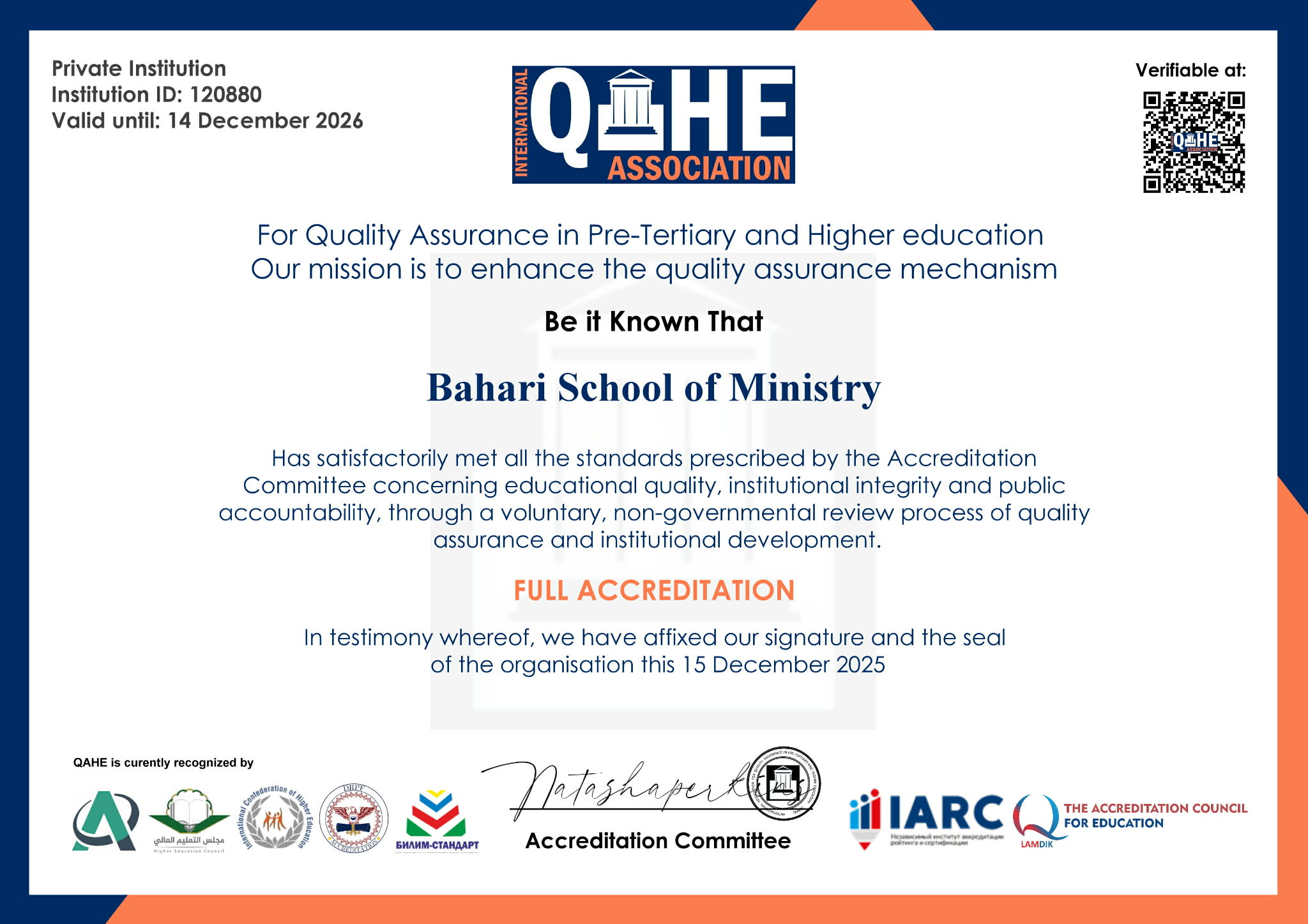
Bahari School of Ministry has been officially awarded international accreditation by the International Association for Quality Assurance in Pre-Tertiary and Higher Education (QAHE), affirming the institution’s compliance with recognized global standards of academic quality, governance, and institutional effectiveness.
Following the first year of continuous operations, Bahari School of Ministry will begin the formal process of seeking national accreditation. International first, then national and eventually regional is our strategic accreditation pathway.
Accreditation is a voluntary, rigorous external review that evaluates programs, faculty, policies, and institutional effectiveness against recognized quality standards. Entering this process at multiple levels reflects the school's commitment to institutional excellence, accountability, and continuous improvement.
Credential Evaluation and Degree Recognition
Bahari School of Ministry awards degrees through programs that meet recognized international quality assurance standards. The institution is internationally accredited and serves a global student population through fully online delivery.
Graduates seeking recognition of their Bahari credentials for employment, professional advancement, or further study may pursue independent credential evaluation through third-party evaluation agencies. Credential evaluation is a standard international process used to assess academic credentials earned outside a specific national education system.
How Credential Evaluation Works
Credential evaluation is conducted by independent agencies that review academic documents and determine comparability within a given national or professional context. The evaluation process typically considers institutional accreditation status, program length, level of study, academic content, and learning outcomes.
Final decisions regarding acceptance or equivalency are made by employers, universities, professional bodies, or licensing authorities. Bahari School of Ministry does not determine equivalency outcomes.
Recommended Credential Evaluation Agencies
Graduates may choose a credential evaluation agency based on their geographic location or intended use of the credential. Commonly used agencies include World Education Services (WES), Educational Credential Evaluators (ECE), UK ENIC, and members of the National Association of Credential Evaluation Services (NACES).
Graduates are responsible for confirming evaluator requirements and selecting the agency most appropriate to their goals.
Institutional Support for Graduates
Bahari School of Ministry supports graduates by providing official academic documentation required for credential evaluation. This may include official transcripts, degree verification letters, program descriptions, syllabi, and accreditation confirmation upon request.
Important Considerations
Credential evaluation does not guarantee acceptance for employment, licensure, or further study. Requirements vary by country, institution, employer, and profession. Students are encouraged to research credential recognition requirements relevant to their specific goals before enrolling and prior to graduation.
Summary Statement
Bahari School of Ministry awards internationally accredited degrees. Graduates may seek independent credential evaluation for recognition in specific national or professional contexts. Acceptance and equivalency decisions rest solely with the receiving institution, employer, or regulatory body.
Important Notice: Bahari School of Ministry is not accredited by any accrediting body recognized by the United States Department of Education. Furthermore, it does not sponsor student visas and does not participate in federal or state financial aid programs.