
Degree Programs and Requirements
Time is like an arrow; once it passes, it does not return.” Swahili Proverb
Our Programs
The Bahari School of Ministry offers undergraduate, graduate, and doctoral degrees designed to prepare culturally grounded leaders in ministry, education, cultural preservation, and community engagement.
Each program includes required core courses, electives, and capstone experiences that integrate ancestral memory, applied practice, and transformative leadership.
Pedagogical Statement
Bahari School of Ministry advances a pedagogical framework grounded in cultural integration, open access to knowledge, and responsible innovation. Teaching and learning at Bahari affirm the lived experiences, histories, and global perspectives of learners, integrating cultural context as a core dimension of academic inquiry rather than an addendum to it.
Our curriculum is built on OER-enabled pedagogy, ensuring that learning materials are openly accessible, adaptable, and equitable. By embedding open educational resources across all programs, Bahari removes cost barriers, encourages collaborative knowledge creation, and empowers students to engage critically with content while contributing to the learning ecosystem themselves.
Ethical AI underpins Bahari’s instructional design, research practices, and skill development. Students are taught not only how to use AI tools proficiently, but how to evaluate their implications, biases, and societal impact. AI is integrated as a support for learning, creativity, analysis, and problem-solving, guided by principles of transparency, accountability, and human judgment.
Together, these pedagogical commitments cultivate learners who are culturally fluent, academically rigorous, technologically proficient, and ethically grounded, prepared to apply knowledge responsibly across professional, civic, and global contexts.
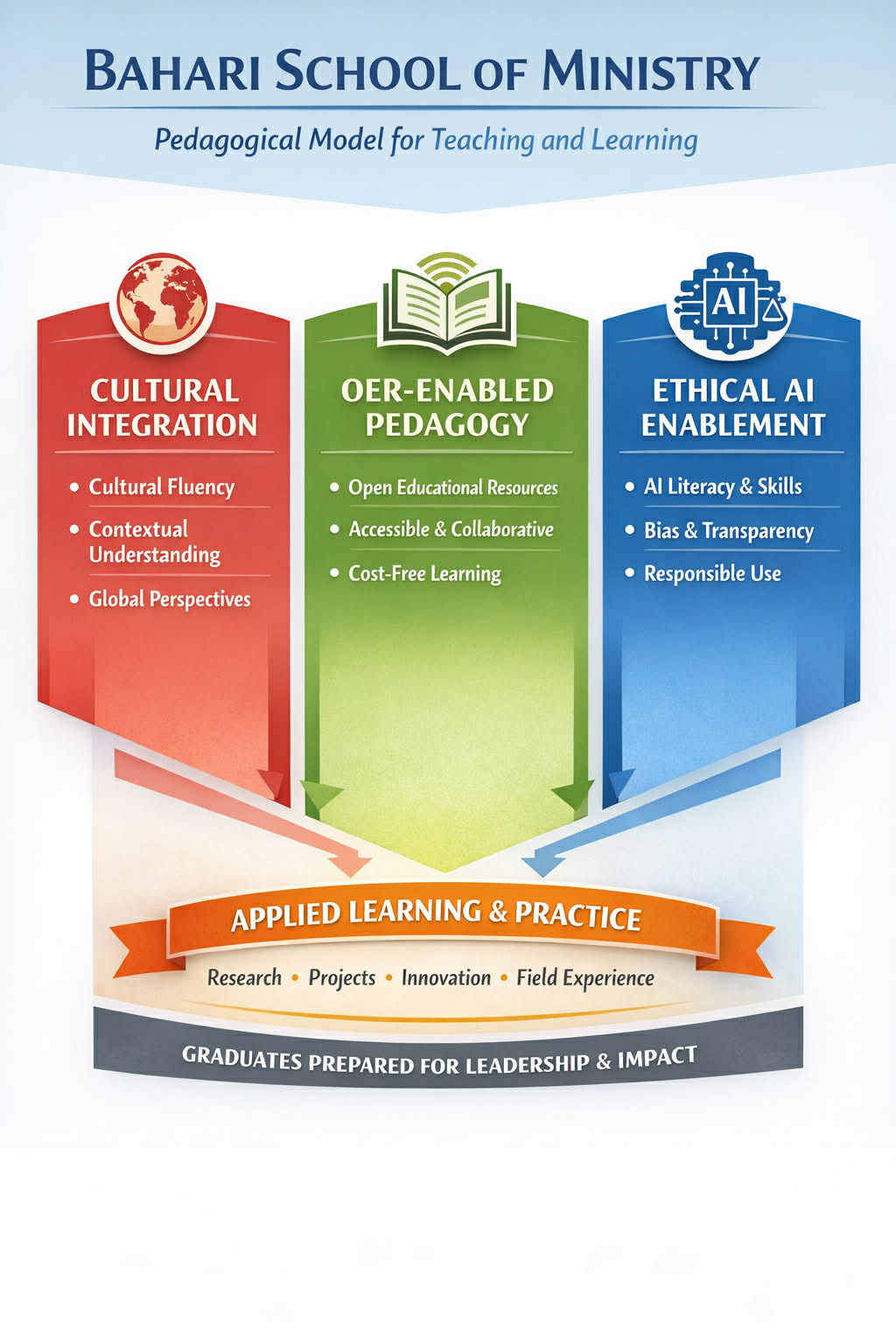
Bahari Pedagogical Framework
Integrated Learning Ecosystem
Core Foundation
Student-Centered Learning
Learners’ lived experiences, cultural knowledge, and global perspectives are the starting point for inquiry, reflection, and application.
Pillar 1
Cultural Integration
Culture is embedded across curriculum design, course content, assessment, and dialogue. Learning affirms identity, historical context, and global interconnectedness, enabling students to interpret knowledge through culturally informed lenses.
- Cultural fluency
- Critical contextual thinking
- Global awareness
Pillar 2
OER-Enabled Pedagogy
Open Educational Resources are integrated across all courses to ensure access, adaptability, and equity. Students engage not only as consumers of knowledge but as contributors through annotation, remixing, and collaborative creation.
- Equitable access
- Cost-free learning materials
- Collaborative knowledge building
Pillar 3
Ethical AI Enablement and Proficiency
AI is embedded as a learning support and analytical tool, guided by ethical standards. Students develop AI literacy alongside critical evaluation of bias, transparency, and societal impact.
- AI proficiency
- Ethical reasoning
- Human-centered decision-making
Convergence Zone
Applied Learning and Leadership
The three pillars intersect to support applied learning, research, innovation, and professional practice.
Graduate Capacities
- Culturally fluent
- Academically rigorous
- OER-literate
- AI-proficient and ethically grounded
- Prepared for leadership, service, and innovation
General Education Program
General Education provides foundational knowledge essential to ministry and community leadership. These courses strengthen critical thinking, communication, cultural understanding, and digital literacy.
Learning Outcomes:
- Think critically and communicate effectively
- Demonstrate knowledge of cultural and historical contexts
- Integrate ethical reasoning in decision-making
- Use AI and digital tools responsibly
- Apply interdisciplinary perspectives in problem-solving
Course Areas: Humanities • Social Sciences • Natural Sciences • Mathematics • Ethics • Arts and Aesthetics • Interdisciplinary Studies • Cultural and Global Perspectives • Afrocentric and Diasporic Studies • AI and Digital Literacy
Undergraduate Programs
Coastal Educational Ministry
Prepares students to serve as culturally grounded educators, community leaders, ministers, and facilitators within African-descended coastal and port city contexts. Graduates will understand historical and cultural frameworks, develop instructional and ministry skills, and engage in spiritually informed leadership.
Note: Graduates of this program will not be qualified for teaching certification.
Program Objectives
- Develop culturally grounded educational strategies
- Incorporate coastal and diasporic history into learning environments
- Apply AI tools for curriculum design and assessment
- Support learners in diverse and under-resourced communities
- Demonstrate leadership in educational ministry
Program Curriculum
Years 1-2: General Education Core (36 credits)
- ENGL 101 English Composition I
- ENGL 102 English Composition II
- MATH 101 College Algebra or Quantitative Reasoning
- MATH 102 Statistics or Critical Thinking
- SOCI 101 Introduction to Social Science
- HIST 110 World Civilizations
- SCI 101 Introduction to Natural Science
- BIO 101 General Biology with Lab or Environmental Science
- COMM 101 Oral Communication
- AAMH 101 African American History or Global Cultures
- MARA 101 Introduction to Maritime Arts and Humanities
- TECH 101 Information Literacy or Technology Skills
Years 3-4: Major Required Courses (36 credits)
- Introduction to Coastal Cultures and History
- Interpretive Methods in Cultural Context
- Public Communications for Educators
- Curriculum Design for Faith Settings
- Culturally Responsive Teaching
- Youth Empowerment in Coastal Communities
- Ethics in Education and Ministry
- Leadership in Educational Service
- Family and Community Collaboration
- Ministry Field Practicum I
- Capstone Seminar in Coastal Educational Ministry
- Senior Project or Applied Ministry Thesis
Electives: 48 credit hours
Program Total: 120 credit hours
Community Leadership Ministry
Prepares students for service in ministry, civic leadership, cultural preservation, advocacy, and community transformation within African and African-descended maritime regions.
Program Objectives
- Understand historical and cultural systems shaping coastal communities
- Engage in effective community organizing and leadership
- Use digital and AI tools to support community initiatives
- Preserve cultural knowledge through storytelling and heritage work
- Lead initiatives promoting justice, resilience, and well-being
Program Curriculum
Years 1-2: General Education Core (36 credits)
- ENGL 101 English Composition I
- ENGL 102 English Composition II
- MATH 101 College Algebra or Quantitative Reasoning
- MATH 102 Statistics or Critical Thinking
- SOCI 101 Introduction to Social Science
- HIST 110 World Civilizations
- SCI 101 Introduction to Natural Science
- BIO 101 General Biology with Lab or Environmental Science
- COMM 101 Oral Communication
- AAMH 101 African American History or Global Cultures
- MARA 101 Introduction to Maritime Arts and Humanities
- TECH 101 Information Literacy or Technology Skills
Years 3-4: Major Required Courses (30 credits)
- Introduction to Community Leadership Ministry
- African Diasporic History and Cultural Identity
- Oral Traditions and Community Storytelling
- Community Organizing and Advocacy
- Arts, Culture, and Social Change
- Public Health Foundations for Coastal Communities
- Leadership in Urban and Coastal Contexts
- Digital Tools for Community Engagement
- AI for Cultural and Civic Innovation
- Capstone in Community Leadership Ministry
Electives: 54 credit hours
Program Total: 120 credit hours
Graduate Programs
Our graduate degree programs prepare students for advanced leadership, ministry practice, cultural research, and community engagement rooted in African and African-descended maritime lifeways. Each program emphasizes scholarship, spiritual grounding, historical understanding, and technological fluency.
Coastal Educational Ministry
Equips students with the advanced skills needed to lead educational initiatives, design culturally responsive curriculum, and serve coastal communities with historical awareness, pedagogical expertise, and ministry insight.
Program Objectives
- Demonstrate advanced knowledge of coastal, maritime, and African-descended community histories
- Design culturally grounded, developmentally appropriate curricula
- Apply effective instructional strategies that support diverse learners
- Integrate spiritual formation and culturally informed pedagogy
- Use digital tools and AI-supported resources to enhance teaching
- Build collaborative partnerships with families and community organizations
- Demonstrate reflective, ethical, and community-accountable leadership
- Evaluate educational programs and assess learning outcomes
Program Curriculum
Core Courses
- Foundations of Coastal Educational Ministry
- Advanced Theories of Learning in Coastal Communities
- Curriculum and Instruction for Maritime Contexts
- Global Perspectives on African Maritime Education
- Spiritual Formation for Educators
- Digital Literacy and AI Tools for Educational Ministry
- Research Methods for Coastal Education
- Culturally Responsive Assessment Practices
Practicum / Fieldwork
- Educational Ministry Practicum
Capstone
- Capstone in Coastal Educational Ministry
Program Total: 30 credit hours
Community Leadership Ministry
Prepares graduates for senior roles in ministry, community development, cultural preservation, advocacy, and organizational leadership in African-descended maritime regions.
Program Objectives
- Demonstrate advanced understanding of community leadership theories and frameworks
- Apply historical knowledge to contemporary ministry challenges
- Design and implement community-based initiatives
- Integrate spiritual leadership and ethical decision-making
- Use strategic planning and partnership building skills
- Employ digital tools and AI-supported technologies
- Facilitate dialogue and conflict navigation in diverse settings
- Evaluate community needs and assess program effectiveness
Program Curriculum
Core Courses
- Foundations of Community Leadership Ministry
- History and Culture of African Maritime Communities
- African and Diasporic Social Movements
- Community Organizing and Transformational Leadership
- Spiritual Formation for Community Leaders
- Public Policy and Civic Engagement
- Digital Tools and AI for Community Leadership
- Research Methods for Community Transformation
Practicum
- Community Leadership Practicum
Capstone
- Capstone in Community Leadership Ministry
Program Total: 30 credit hours
Master of Ministry in Sports Diplomacy
Equips students with advanced skills to use sport as a tool for international engagement, peacebuilding, cultural exchange, and ethical leadership, integrating ministry formation, global affairs, and community-centered diplomacy.
Program Objectives
- Demonstrate advanced understanding of sports diplomacy as a tool of international relations and soft power
- Analyze the role of sport in peacebuilding, conflict resolution, and cross-cultural engagement
- Apply ethical, spiritual, and values-based leadership within global sports contexts
- Design sports-based initiatives that foster community development and international cooperation
- Integrate ministry principles with diplomacy, cultural intelligence, and global engagement
- Utilize digital platforms and AI-supported tools to support global sports initiatives
- Build partnerships with international organizations, governments, and community institutions
- Demonstrate reflective, ethical, and globally accountable leadership practice
Program Curriculum
Core Courses
- Foundations of Sports Diplomacy and Ministry
- Global Politics, Soft Power, and Sport
- Sport, Culture, and International Community Building
- Ethics, Faith, and Leadership in Global Sport
- Peacebuilding, Conflict Resolution, and Sport
- Digital Strategy and AI Tools for Sports Diplomacy
- Research Methods for Global Ministry and Diplomacy
- Program Design and Evaluation for Sports-Based Initiatives
Practicum / Fieldwork
- Sports Diplomacy Practicum
Capstone
- Capstone in Sports Diplomacy and Ministry
Program Total: 30 credit hours
Doctoral Programs
Our doctoral programs offer rigorous training for leaders pursuing scholarship, ministry practice, cultural preservation, community transformation, and advanced research related to African and African-descended maritime lifeways. Doctoral programs combine historical study, technology and AI integration, interdisciplinary inquiry, applied leadership, and spiritual grounding.
Coastal Community Leadership
Designed for experienced leaders seeking advanced preparation for ministry grounded in technological expertise, community development, educational leadership, and cultural heritage stewardship in maritime and coastal contexts.
Program Objectives
- Demonstrate advanced, practice-based leadership grounded in maritime community histories
- Integrate community development strategies with technological fluency
- Design, implement, and assess community initiatives for coastal resilience
- Apply ethical, culturally informed, and community-accountable practices
- Use advanced research methods including qualitative inquiry and AI tools
- Facilitate dialogue and partnership building across networks
- Lead effectively in ecologically vulnerable environments
- Produce a doctoral-level capstone with scholarly rigor and practical impact
Program Curriculum
Doctoral Seminars
- Lifeways of African and African-Descended Maritime Populations
- Coastal Governance, Policy, and Community Systems
- Cultural Landscapes and Maritime Identity
- Leadership Strategies for Coastal and Port Communities
- Community Development and Sustainable Coastal Futures
- Conflict Resolution and Mediation in Coastal Contexts
- Planning and Partnership Building for Coastal Initiatives
Formation Courses
- Doctoral Formation and Reflective Practice I
- Doctoral Formation and Reflective Practice II
Capstone
- Doctoral Capstone in Coastal Community Leadership
Program Total: 30 credit hours
African Diasporic History and Cultural Ministry
Prepares leaders for scholarship, ministry, cultural preservation, and narrative stewardship, emphasizing African Diasporic history, memory, cultural expression, and maritime knowledge systems.
Program Objectives
- Demonstrate advanced knowledge of African Diasporic history and cultural memory
- Design and lead cultural preservation initiatives
- Integrate digital humanities methods and AI-supported research
- Apply ethical and community-accountable leadership practices
- Conduct advanced qualitative research and field inquiry
- Collaborate with museums and cultural institutions
- Lead in environments where representation and interpretation intersect
- Produce a doctoral capstone demonstrating cultural stewardship
Program Curriculum
Doctoral Seminars
- Cultural Memory, Continuity, and Community Leadership
- Creative Expressions in Diasporic Communities
- Digital Archiving and AI Tools for Cultural Preservation
- AI Enhanced Research and Collaborative Project Design
- Leadership in Community Heritage and Cultural Stewardship
- Models of Cultural Ministry in Diasporic Contexts
- Ethics, Narrative Authority, and Community Representation
Formation Courses
- Doctoral Formation and Reflective Practice I
- Doctoral Formation and Reflective Practice II
Capstone
- Doctoral Capstone in African Diasporic History and Cultural Ministry
Program Total: 30 credit hours
PhD in Global Diplomatic Sports Ministry
Designed for scholar practitioners seeking advanced academic and applied preparation to study, teach, and lead at the intersection of sport, diplomacy, service-based ministry, ethics, and global affairs, with emphasis on research, policy, and transformative international engagement.
Program Objectives
- Demonstrate advanced scholarly expertise in global sports diplomacy and service-centered ministry
- Analyze sport as a diplomatic, cultural, political, and ethical system within global contexts
- Conduct original, rigorous research that contributes to theory and practice in sports diplomacy and ministry as service
- Integrate ethical leadership, cultural intelligence, and global service frameworks
- Apply advanced qualitative, practice-based, and AI-supported research methodologies
- Examine governance, policy, and power structures shaping international sport
- Produce an applied doctoral capstone with global relevance and professional impact
- Demonstrate advanced reflective practice and scholarly leadership in global sports diplomacy
Program Curriculum
Doctoral Seminars
- Theoretical Foundations of Global Sports Diplomacy
- Sport, Service, and Ethical Leadership in International Contexts
- Diplomacy, Soft Power, and Global Cultural Systems
- Global Sport Governance, Policy, and Institutions
- Ethics, Human Rights, and Accountability in International Sport
- Advanced Research Methods for Global Sports Ministry
- AI and Digital Tools for Global Research and Program Analysis
Formation Courses
- Doctoral Formation and Reflective Practice I
- Doctoral Formation and Reflective Practice II
Capstone
- Doctoral Capstone in Global Diplomatic Sports Ministry
Program Total: 30 credit hours
Career Outlook & Economic Context
Bahari School of Ministry prepares graduates for service-centered careers grounded in ministry as service, community care, cultural stewardship, and mission-driven leadership. Graduates are prepared for work within churches, faith-based nonprofits, cultural ministries, mission organizations, and community-serving institutions. In addition to salaried roles, many graduates sustain their work through entrepreneurship and gig-based service models that reflect current economic realities and allow ministry leaders to build diversified and sustainable income streams.
Across all degree levels, Bahari programs align with service economies supported by church budgets, grants, philanthropy, donations, program fees, mission partnerships, and community sponsorships. Graduates develop the capacity to lead organizations, launch ministries, manage projects, secure funding, design fee-supported programs, and use digital and AI-supported tools to expand reach and sustainability. The overview below presents the roles graduates will likely hold, job outlook trends, and economic indicators relevant to service-based ministry contexts.
Coastal Educational Ministry
Roles: Education coordinator, program assistant, curriculum support staff, workshop facilitator, tutor, community education aide within churches, faith-based learning programs, and nonprofit learning organizations.
Demand: Remains steady as churches and community ministries expand education outreach, youth programming, and culturally grounded learning.
Income: $40,000 to $65,000 (salaried). Frequently supplemented through program fees, short-term contracts, and grant-supported projects.
Community Leadership Ministry
Roles: Outreach coordinator, community ministry assistant, program coordinator, advocacy assistant, and organizing support roles within churches and faith-based nonprofits.
Demand: Steady due to ongoing needs in outreach, care services, cultural continuity, and advocacy. Project-based and grant-funded roles are common.
Income: $40,000 to $70,000. Entrepreneurial income may include donations, grants, sponsorships, and program fees.
Coastal Educational Ministry
Roles: Director of education ministry, training coordinator, curriculum designer, learning program manager, senior educator, and independent education consultant.
Demand: Growing for leaders who can manage education programs, expand learning initiatives, and integrate digital tools.
Income: $60,000 to $90,000. Additional income often comes from consulting fees, curriculum licensing, and training contracts.
Community Leadership Ministry
Roles: Senior program manager, ministry director, nonprofit administrator, community development leader, organizational strategist, and independent consultant/facilitator.
Demand: Leadership demand remains steady as organizations seek experienced leaders capable of managing programs, funding, and partnerships.
Income: $65,000 to $100,000. Consulting, facilitation, and project-based work frequently supplements salaries.
Master of Ministry in Sports Diplomacy
Roles: Sport ministry director, youth development leader, program coordinator for sport-based service initiatives, international exchange facilitator, and partnership manager.
Demand: Continues to grow for sport-based service programs focused on youth engagement, peacebuilding, and cross-cultural connection.
Income: $50,000 to $85,000. Income may include salaries, program fees, grants, and mission-aligned sponsorships.
Coastal Community Leadership
Roles: Executive director, senior ministry leader, strategic adviser, systems-level coordinator, and lead consultant within churches, mission networks, and service organizations.
Demand: Leadership demand remains stable due to ongoing transitions and long-term service needs.
Income: $80,000 to $125,000. Contract-based advisory and consulting roles often increase earning capacity.
African Diasporic History and Cultural Ministry
Roles: Director of cultural ministry, heritage center leader, archive or memory project director, senior educator, research program leader, cultural adviser, and scholar.
Demand: Steady due to leadership transitions and increased focus on cultural memory, preservation, and community accountability.
Income: $65,000 to $115,000. Income sources include institutional support, grants, donations, speaking engagements, and project-based work.
PhD in Global Diplomatic Sports Ministry
Roles: Senior adviser for faith-based sport ministries; director of sport-for-peace initiatives; research and program lead for international mission organizations; youth diplomacy program director; founder or executive leader of mission-aligned sport and diplomacy initiatives; independent consultant or convener supporting multiple organizations.
Demand: Steady and expanding demand as faith-based and mission-driven organizations increasingly use sport for youth engagement, peacebuilding, reconciliation, leadership development, and cross-cultural exchange. Growth is supported by international service programs, grant-funded initiatives, and leadership turnover within global ministry networks.
Income: $75,000 to $125,000. Typical annual income in senior leadership, research, or program director roles. Independent and portfolio-based leaders often combine grants, consulting retainers, program fees, fellowships, speaking engagements, and international partnerships, with total earnings varying based on scope of projects and funding sources.